Trademark Registration Fees in Indonesia for MSMEs and the General Public
Highlights
- Trademark registration fees in Indonesia vary depending on whether the applicant falls under the MSME or general category.
- Trademark protection is valid for ten years and must be renewed, with higher fees applying if the renewal is submitted after the expiration date.
- Additional costs may apply for other legal services, such as filing an objection to a similar trademark, submitting an appeal if the application is rejected, or recording the transfer of trademark rights.
- Choosing the appropriate trademark class is crucial because registration fees are calculated per class, and legal protection only applies to the registered category.
Trademark Registration Fees in Indonesia: 2026 Costs and Registration Process
Did you know that Indonesia’s trademark system follows the first-to-file principle?
This means that trademark rights are generally granted to the party that files the application first, rather than the party that used the trademark first. DJKI explicitly describes Indonesia as a first-to-file system under the Trademark Law.
A business that has been operating for years could potentially lose the name and logo it has worked hard to build simply because another party registered them first.
Unfortunately, many people are hesitant to deal with legal matters because they assume the costs will be expensive.
So, let’s find out how much trademark registration costs and how to register a trademark to help prevent this situation from happening to your business.
Understanding Trademark Rights and What They Protect
Law No. 20 of 2016 on Trademarks and Geographical Indications defines a trademark as a graphic sign that distinguishes the goods or services of one party from those of another.
In simple terms, a trademark is an identity that allows customers to immediately recognize your products or services and distinguish them from competitors.
So, what types of marks can be protected by trademark rights?
The scope is actually quite broad. It can include names, words, letters, numbers, logos, images, and combinations of colors.
Two-dimensional and three-dimensional forms, sounds, and holograms can also be registered as trademarks. Combinations of two or more of these elements may also qualify for trademark registration, subject to the applicable requirements.
Once a trademark is registered, the owner obtains exclusive rights to use the trademark commercially, prevent other parties from using a similar trademark without authorization, and license or transfer the trademark rights, subject to applicable law.
Trademark protection is generally valid for ten years from the filing date and can be renewed.
So, how much does trademark registration cost to obtain this protection?
2026 Trademark Registration Fees at DJKI
The official trademark registration fees in Indonesia are determined by government regulations on non-tax state revenue (PNBP). The applicable tariff framework includes Government Regulation No. 45 of 2024, while the current 2026 tariff framework should be checked against the latest DJKI regulations before filing.
Trademark registration fees depend largely on the number of trademark classes being registered. For example, food products and fashion products belong to different trademark classes.
Therefore, even if your fashion and food products use the same trademark, they may need to be registered separately under the relevant classes.
If you register one trademark in two different classes, the registration fee will generally be charged for each class.
However, trademark registration costs do not only arise during the initial application. There are several other fees you may need to pay throughout the life of your trademark protection.
New Trademark Registration Fees
Here are the trademark registration fees for a new application:
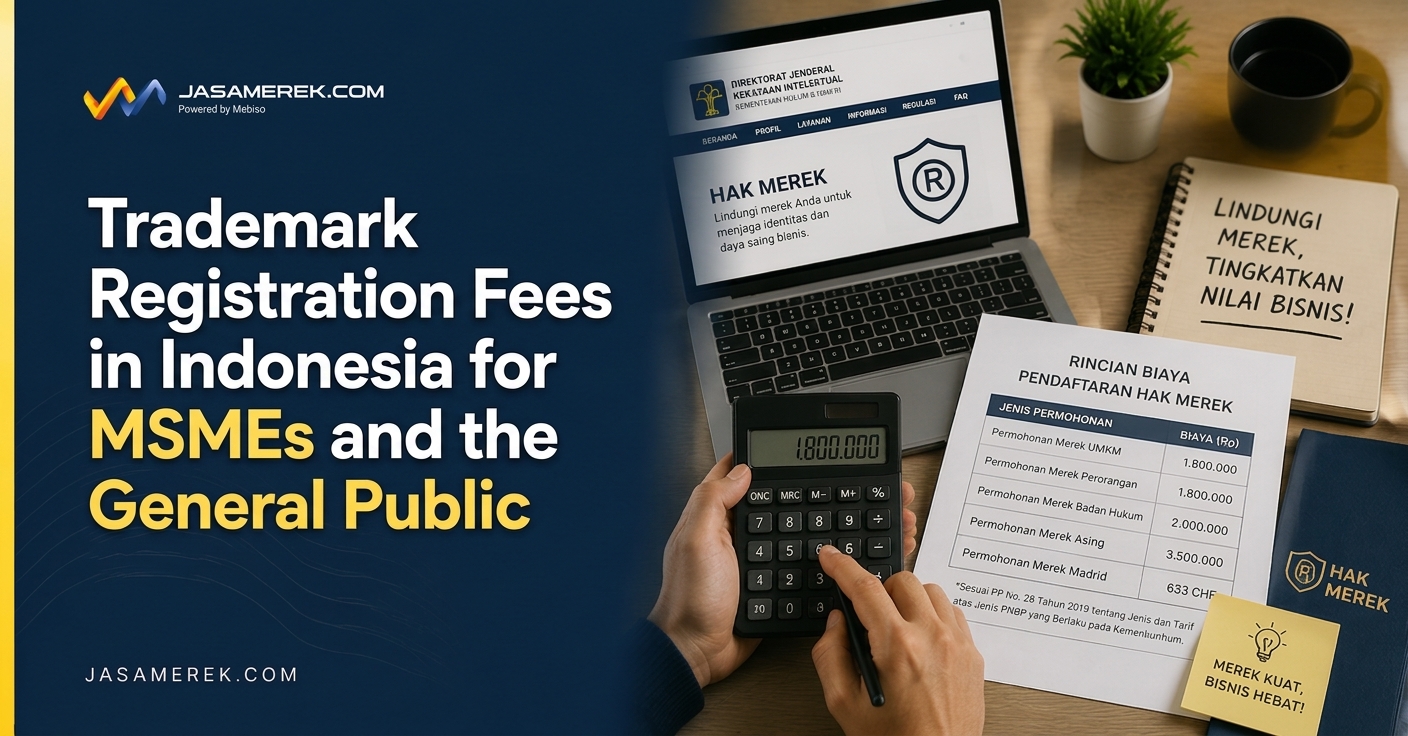
- For Micro and Small Business (UMK) applicants, the online registration fee is IDR 500,000 per class. The official tariff for general applicants is IDR 1,800,000 per class. DJKI materials confirm these special UMK and general tariffs.
- UMK applicants must also provide the required supporting documentation proving their eligibility for the special tariff when submitting an application. Without the required document, the general tariff may apply.
- For general applicants, individuals, and legal entities, the trademark registration fee is IDR 1,800,000 per class. Applicants should check the current DJKI system for the applicable submission method and fee before filing.
Trademark Protection Renewal Fees
A trademark registration is valid for ten years. After that period, you must renew the protection if you want to maintain your exclusive trademark rights.
A renewal application can be submitted starting six months before the expiration date.
There is also a grace period of up to six months after the expiration date, although higher fees may apply.
1. Renewal submitted six months before or up to the expiration date
For UMK applicants, the fee is IDR 1,000,000 per class, while general applicants must pay IDR 2,250,000 per class. These amounts are listed in the applicable government tariff regulation.
2. Renewal submitted within six months after the expiration date
If an UMK applicant submits the renewal after the expiration date, the fee is IDR 2,000,000 per class, while the fee for general applicants is IDR 4,500,000 per class.
If you fail to renew your trademark within the applicable period, your trademark protection may lapse. A trademark that has been built over many years could then potentially become available for registration by another party, subject to the applicable legal requirements.
Once your trademark rights have expired, you may no longer have the same legal basis to prevent another party from seeking registration of the mark.
Other Trademark Service Fees
In addition to new applications and renewals, there are several other trademark-related services that you may need during the course of your business.
Here are some examples:
1. Filing an Opposition
An opposition can be filed when you discover that another party has applied for a trademark that you believe is similar to yours. You can submit an objection to DJKI during the applicable publication period.
The fee is IDR 1,000,000 per application.
2. Trademark Appeal
You may file a trademark appeal if your trademark application is rejected. The appeal fee is IDR 3,000,000 per application.
3. Recording a Transfer of Trademark Rights
A transfer of trademark rights may occur when you sell a business, acquire a business, or transfer the business through inheritance. The change in ownership should be officially recorded to clarify the legal status of the trademark.
The fee is IDR 700,000 per registered number, subject to the applicable tariff.
4. Recording a License Agreement
Recording a trademark license may be relevant when your business operates under a franchise or partnership system. While the underlying license agreement may have legal effect between the parties, recording it can provide additional legal certainty and protection.
The applicable fee is IDR 1,000,000 per registered number, subject to the current tariff.
5. Changing the Owner’s Name or Address
If the trademark owner’s name or address changes, the change should also be recorded with DJKI.
The fee is IDR 300,000 per registered number.
Case Study: How Much Should You Prepare for Trademark Registration?
After reviewing the trademark registration fees above, can you estimate how much you would need to spend to register your business trademark?
If not, let’s look at these case studies to make the calculation easier to understand.
Case Study 1: Processed Food and Restaurant Business
Jake starts a culinary business under his own trademark. His main product is packaged food, such as bottled chili sauce, which is sold in supermarkets.
At the same time, Jake also operates a restaurant.
The packaged food falls under Class 29, while restaurant and café services fall under Class 43. Therefore, Jake needs to register his trademark in both classes.
For a general applicant, the initial registration fee is IDR 1,800,000 per class. Therefore, the total cost is IDR 3,600,000 for two classes.
Ten years later, when the renewal period arrives, Jake needs to prepare IDR 4,500,000 if he submits the renewal within the applicable regular renewal period.
However, if he submits the renewal after the expiration date but within the applicable grace period, Jake would need to pay IDR 9,000,000 for two classes.
Case Study 2: Fashion Brand
Carmen starts a local clothing brand and registers as an UMK. Her products include clothing and footwear.
Both clothing and footwear fall under Class 25.
Because the products fall under the same class, Carmen only needs to pay IDR 500,000 to submit an online trademark application under the special UMK tariff, assuming she meets the eligibility requirements.
Ten years later, Carmen submits her renewal within the applicable period and pays IDR 1,000,000.
Do these two case studies make the calculation clearer? Or are you still confused?
If you’re still unsure, don’t worry. In practice, determining the correct trademark class is not as simple as choosing an item from a list.
The Nice Classification consists of 45 classes, with thousands of goods and services covered within those classes.
Choosing the wrong class can have significant consequences because the protection may not adequately cover your business activities, or the application may encounter issues during examination.
There are also several other steps involved, including conducting a trademark search to make sure there are no similar marks that have already been registered, completing the application form accurately, and monitoring the application status regularly.
You may also need to respond if another party files an opposition against your application.
All of these processes require considerable time and attention.
For business owners who already have busy schedules managing daily operations, administrative procedures like these can become an additional burden.
FAQ
1. Where can I register a trademark in Indonesia?
Trademark applications in Indonesia can be submitted through the official Directorate General of Intellectual Property (DJKI) trademark system. Applicants should use the current official DJKI portal and check the latest application procedures before submitting an application.
2. Can I register a trademark myself?
Yes. You can submit a trademark application yourself through the official DJKI online system or follow the applicable offline procedures.
3. Do I need a Taxpayer Identification Number (NPWP) to register a trademark?
An individual may be able to apply for a trademark without submitting an NPWP, depending on the applicable application requirements. Check the current DJKI requirements before submitting your application.
Handle Your Trademark Registration with a Trusted Professional!
Trademark registration fees are relatively affordable when compared with the business value and brand equity at stake. However, the fees stated above should always be checked against the latest official DJKI tariff before you submit an application.
Losing a trademark can mean losing customer recognition, market trust, and years of investment in marketing and brand development.
The registration process also requires careful attention. Choosing the wrong class or making errors in the application documents can create problems during the examination process.
Registration fees that have already been paid may also not be refundable if an application is ultimately rejected, depending on the applicable rules.
For business owners who want to focus on developing their businesses, working with professional trademark registration services can be a practical option.
Entrust your business trademark registration process to our expert team at Trademark Registration Services.
We can assist you with the process, from trademark searches and selecting the appropriate classes to the issuance of the trademark certificate. Contact us and schedule an initial consultation!


Tagged with:
JM AwareRelated Articles







 Home
 Articles

 Search
 Menu