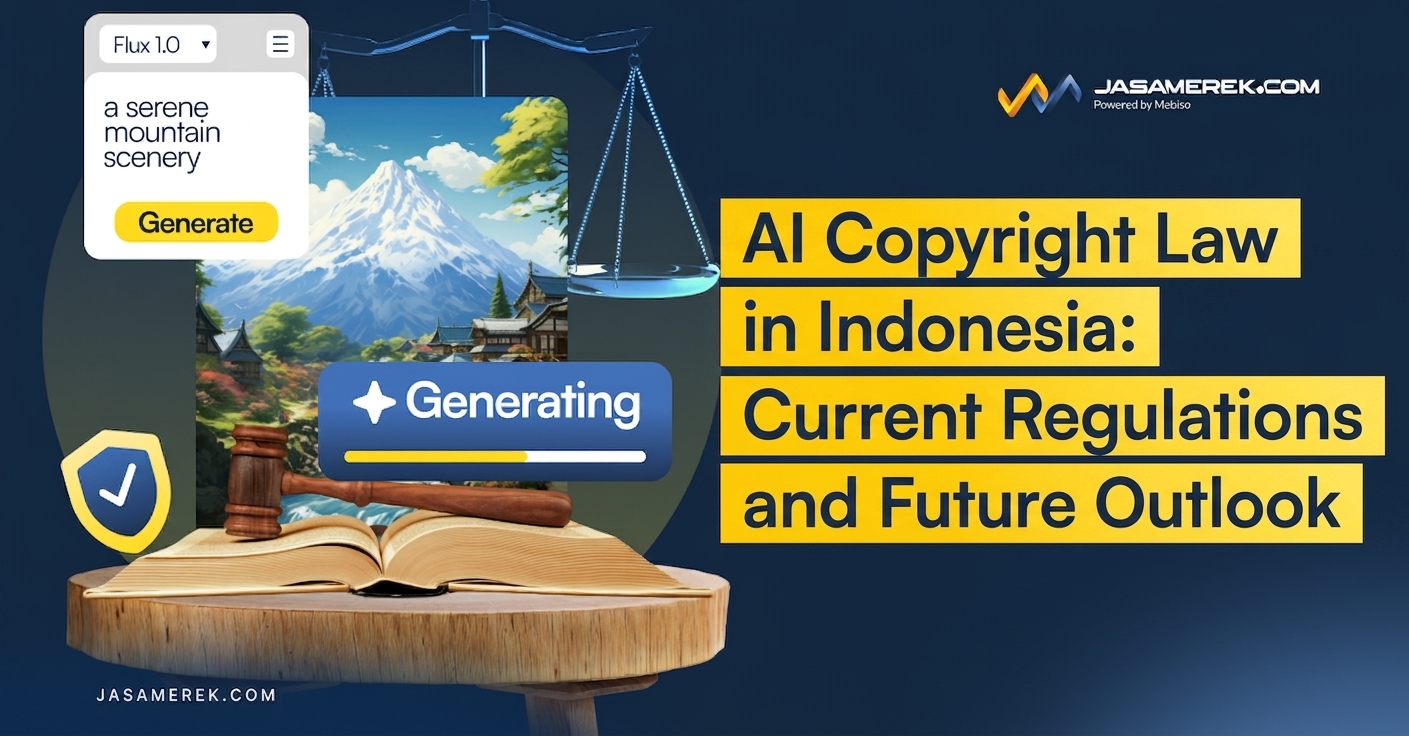
AI Copyright Law in Indonesia: Current Regulations and Future Outlook
Artificial intelligence (AI) has become an undeniable part of modern life. In recent years, AI has rapidly evolved into one of the world’s most transformative technologies, reshaping how people create, work, and communicate. At the same time, the need for clear AI copyright regulations has become increasingly important in Indonesia.
As AI-generated content becomes more common—from text and images to music and videos—questions surrounding copyright ownership and legal protection continue to grow. Businesses, creators, and legal professionals are all asking the same question:
How does Indonesian copyright law apply to AI-generated works?
This article explores the current legal landscape and discusses what future AI copyright regulations in Indonesia may look like.
Why Indonesia Needs AI Copyright Regulations
AI technology is capable of performing tasks that once required human intelligence. From writing articles to generating artwork and videos, AI has become an essential tool for individuals and businesses alike.
However, as AI capabilities continue to expand, so do the legal questions surrounding its use.
One of the most frequently asked questions is:
Does Indonesia already have copyright laws that specifically regulate AI-generated works?
To answer this, it’s important to first understand what AI is.
Artificial Intelligence (AI) refers to computer systems designed to simulate human intelligence. These systems can learn, analyze information, recognize patterns, solve problems, and even generate creative content.
Because of these capabilities, AI is often described as technology that mimics aspects of human intelligence.
Today, AI applications can generate:
- Written content
- Images and illustrations
- Videos
- Computer code
- Music
- Other creative outputs
While these technological advances offer enormous opportunities, they also create new legal challenges.
Clear regulations are necessary to provide legal certainty regarding both AI systems and the content they generate.
Does Indonesia Have an AI Copyright Law?
At present, Indonesia does not have a law that specifically regulates copyright for AI-generated works.
Indonesia’s current copyright framework is governed by Law No. 28 of 2014 on Copyright, which was drafted before the widespread adoption of generative AI.
The existing law primarily addresses conventional creative works—such as literature, art, music, and scientific works—and does not explicitly discuss:
- AI-generated content
- AI-assisted creativity
- Copyright ownership of AI-generated works
- Rights of AI users
- Rights relating to AI-generated images or videos
As a result, many legal questions remain unanswered.
For this reason, many legal experts believe Indonesia should revise its Copyright Law to address AI and provide greater legal certainty for creators, businesses, and technology developers.
What Should Future AI Copyright Regulations Cover?
Although Indonesia has not yet enacted a dedicated AI copyright law, government officials have indicated that revisions to the Copyright Law are under discussion.
According to various public reports, the Indonesian government is considering updates that would specifically address copyright issues involving artificial intelligence.
However, as of the time of writing, no official timeline has been announced for when these amendments will be enacted.
If new legislation is introduced, several important issues are expected to receive attention.
1. Copyright Protection for AI-Generated Images
One of the most debated issues worldwide concerns copyright ownership of AI-generated images.
Some legal experts argue that fully AI-generated images should not receive copyright protection because they are produced automatically by software rather than through human creativity.
Others believe copyright protection may still apply if AI is used merely as a creative tool and the human user makes meaningful creative decisions throughout the process.
Read also: How to Obtain a Copyright Certificate
Because there is currently no definitive legal answer under Indonesian law, clear legislation addressing AI-generated images would provide much-needed certainty for creators and businesses.
2. The Legal Status of AI Users
Another major issue concerns the role of the person using AI.
Should someone who writes prompts, edits AI outputs, and directs the creative process be recognized as the creator?
Under Indonesia’s current Copyright Law, a creator is defined as an individual or group of individuals who independently or jointly produce an original work with distinctive personal characteristics.
A key element of this definition is originality.
Traditionally, copyright protects original human expression.
However, questions arise when AI generates content based on prompts provided by a user.
On one hand, the user determines the concept, style, and creative direction through prompts and editing.
On the other hand, AI systems generate outputs by analyzing and processing vast amounts of existing data through sophisticated algorithms.
This creates uncertainty regarding whether the user, the AI developer, or neither should be recognized as the copyright owner.
These issues are among the most important topics that future Indonesian AI copyright legislation will likely need to address.
Protecting Your Creative Works Still Matters
Even though copyright protection generally arises automatically once an original work is fixed in a tangible form, infringement remains a significant concern.
Unauthorized copying, plagiarism, and misuse of creative works continue to occur across many industries.
Registering your copyright provides stronger legal evidence of ownership and can make it easier to enforce your rights if disputes arise.
With Jasa Merek’s Copyright Registration Service, protecting your creative works in Indonesia is simple and hassle-free.
Our experienced intellectual property professionals can assist you throughout the registration process, helping you secure stronger legal protection for your creative assets.
Protect your work today—before someone else tries to claim it tomorrow.
Frequently Asked Questions
What is artificial intelligence (AI)?
Artificial Intelligence (AI) refers to computer systems designed to simulate human intelligence, including the ability to learn, analyze information, solve problems, and make decisions.
Can AI generate more than text?
Yes. Modern AI systems can generate many types of content, including text, images, videos, music, software code, and other creative works.
Does Indonesia currently have an AI Copyright Law?
No. Indonesia does not yet have legislation that specifically regulates copyright ownership and protection for AI-generated works.
What topics might future AI copyright regulations cover?
Although no official law has been enacted, future regulations may address issues such as copyright ownership of AI-generated images, the legal status of AI users as creators, and other copyright issues involving AI-generated content.
Can AI-generated images receive copyright protection?
The legal status of AI-generated images remains uncertain in Indonesia. Some legal experts argue they may qualify for protection when there is sufficient human creative involvement, while others believe fully AI-generated works should not receive copyright protection. Clear legislative guidance is expected to provide greater certainty in the future.


Tagged with:
Hak Cipta UnawareRelated Articles



 Home
Home
 Articles

 Search
 Menu
Menu